Key takeaways
- One bench and a pair of dumbbells cover a complete session: three presses, a dip, a split squat, and a hip thrust, each 3 sets of 8 to 12, with the flat press at 3 sets of 8 to 10 and the split squat at 3 sets of 8 on each side.
- The hip thrust is the only barbell move — skip it and the other five moves still make a complete session; run the session twice a week, with a rest day between.
- Progress slowly over four weeks: add reps first, then a set, then a weight, never more reps and more weight at once; and do not lock the elbows at the top of the press, shrug through the dip, or collapse on the hip thrust's way down.
What you need, and what the bench is for
A bench changes what a pair of dumbbells can do at home. Without one, every press starts from the floor and every leg move is standing. With one, the same dumbbells cover chest, triceps, legs, and glutes in a single session. This bench workout at home with dumbbells uses six moves from the Setline catalog: three presses, a dip, a split squat, and a hip thrust. Every step and set below matches its detail page. The Bench hub lists 25 exercises; this article turns six of them into one session you can repeat twice a week.
You need an adjustable bench that stays put, a pair of dumbbells, and enough floor space to lie flat beside the bench. That is the whole kit for five of the six moves. The sixth, the hip thrust, is the only one that needs a barbell; if you do not have one, run the other five and the session is still complete.
The bench does three jobs here. Flat, it is the platform for the press and the dip. Raised to an incline, it changes the press angle. Turned around, it supports the rear foot for the split squat and the back for the hip thrust. Before the first set, sit on it, lie on it, and push it from the side: if it rocks or slides, fix the footing first.
Bench workout at home with dumbbells: the six-move session
Do them in order, with 60 to 90 seconds between sets. Steps and sets match each move's detail page.
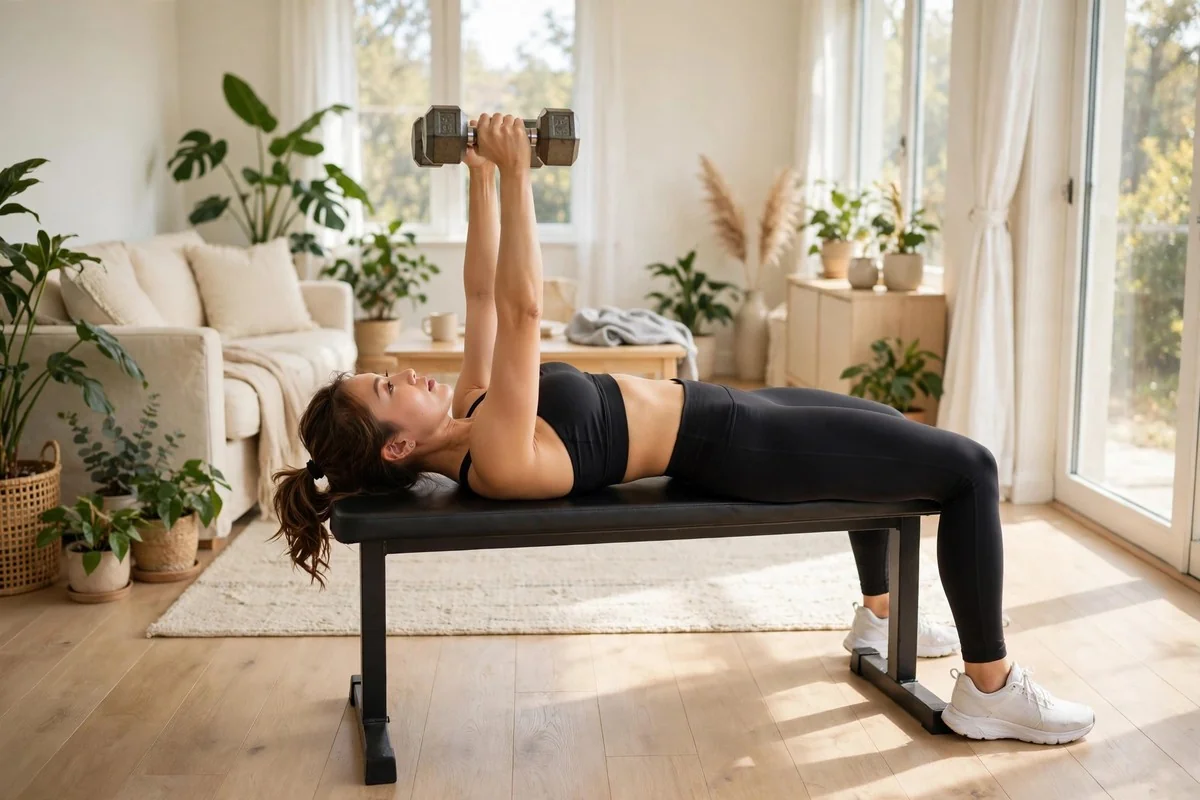
**1. Dumbbell press, 3 sets of 8 to 10.** Lie on the bench, weights above the chest. Lower to the sides of the ribs, then press up without locking hard. Keep the ribs down and the feet flat; the press is a chest move, not a back arch. (Dumbbell press)
**2. Incline dumbbell press, 3 sets of 8 to 12.** Lie back on an incline bench, a dumbbell in each hand at shoulder width, palms facing forward. Press the dumbbells straight up until your arms are long, then lower them slowly back to shoulder height. Go lighter than the flat press: the incline is a smaller range with less help from the lower chest. (Incline dumbbell press)
**3. Close-grip dumbbell press, 3 sets of 8 to 12.** Lie across a bench with only your shoulders supported, holding one dumbbell with both hands over your chest. Lower the dumbbell toward your chest, then extend the elbows to press it back up. This one is for the triceps, so keep the elbows close and let them do the work. (Close-grip dumbbell press)
**4. Bench dip, 3 sets of 8 to 12.** Hands on the bench edge, hips in front. Bend the elbows and lower the shoulders, then press back up without shrugging. Keep the shoulders down through the whole rep. A low, sturdy chair that will not slide works if your bench is occupied. (Bench dip)
**5. Dumbbell Bulgarian split squat, 3 sets of 8 on each side.** Rear foot on the bench, weights by the sides. Lower the front thigh, then press the front foot to stand. The rear leg is a balance aid, not a second working leg: if it burns more than the front one, shift your weight forward. (Dumbbell Bulgarian split squat)
**6. Barbell hip thrust, 3 sets of 8 to 12.** Upper back on the bench, bar over the hips. Press through the heels and lift the hips, squeeze, then lower without collapsing. The top position is a straight line from shoulders to knees; if the lower back arches, the weight is too heavy. (Barbell hip thrust)
How to set up the bench for each move
The flat press and the dip use the bench flat. The incline press needs the back raised one or two notches: enough to feel the upper chest work, not so steep that it becomes a shoulder press. The split squat uses the bench at knee height with the rear foot resting on the pad. The hip thrust uses the bench sideways behind you, upper back on the edge so the shoulder blades can pivot.
How to progress it over four weeks
Week one is for learning the positions: light weight, slow movement, stop one rep before your form breaks. The Bulgarian split squat will feel awkward before it feels hard; that is normal. In week two, add one rep to every set. In week three, add a fourth set to the two presses. In week four, move up a weight once you can finish all sets at the top of the range with clean form. More reps first, then more weight, never both at once.
Run it twice a week with a day between sessions. If bench work is new to you, pair this session with a lighter dumbbell day from our dumbbell workout at home guide. If chest is the focus, our dumbbell chest workout at home guide shows how the press variations fit a bigger chest week.
Three mistakes that waste a bench session
First, locking the elbows hard at the top of the press. The press page says it plainly: press up without locking hard. A locked elbow hands the weight to the joint and takes it off the chest. Second, shrugging through the dip. The dip page warns against it for a reason: raised shoulders turn a triceps move into a neck ache. Third, collapsing on the way down of the hip thrust. The page says lower without collapsing; the lowering phase is half the set.
Turn this session into a plan
Six moves and one bench are enough for a session, but a plan is what makes the second month happen. Take the Setline quiz: it builds a personal plan from the same catalog, with your equipment, time, and level factored in. Pro opens the full plan and all 25 bench exercises: see pricing for the 14-day free trial, then $6.99 a month, $39.99 a year, or $79.99 for lifetime.
Common questions
Do I need a barbell for this bench workout?
Only for the last move. Five of the six moves need dumbbells and a bench; the hip thrust is the only barbell move. Skip it and the session still covers chest, triceps, and legs.
Can I do this workout with an adjustable bench only?
Yes. Flat covers the press and the dip, one raised notch covers the incline press, and the bench turned sideways covers the hip thrust. No second bench or rack is needed.
How many times a week should I do this bench workout?
Twice a week, with at least one rest day between. Our guide on how many days a week to work out covers how to fit this session into your week.
What weight dumbbells should I start with?
A pair you can press 8 times with strict form, no bouncing, with one or two reps in reserve. The incline press and the split squat will want lighter weights than the flat press; start with the same pair and adjust by feel, not by ego.