Key takeaways
- No bench is required. The floor press, floor fly and pullover load the chest directly, and the floor sets the same bottom position on every rep, so form stays repeatable as you tire.
- Run the loaded dumbbell moves first and the push-up variations after, twice a week with a rest day between sessions; short on time, the three dumbbell moves plus one push-up variation still cover the session.
- Progress is the load, not more exercises: when all six moves reach the top of their rep ranges with clean form, the weights go up next time.
What you need, and what you do not
Most chest training advice assumes a bench. If your training space is a living room floor, that advice stops being useful fast. This dumbbell chest workout at home is built for the floor instead: three dumbbell moves that load the chest directly, plus three push-up variations that add the angles a bench would normally give you. One pair of dumbbells and clear floor is the whole setup.
You need one pair of dumbbells and enough floor to lie down with arms open. A mat helps on hard floors, but it is optional. No bench, no rack, no cable machine. The full dumbbell exercise library runs to 44 exercises, and the three dumbbell moves below use dumbbells only.
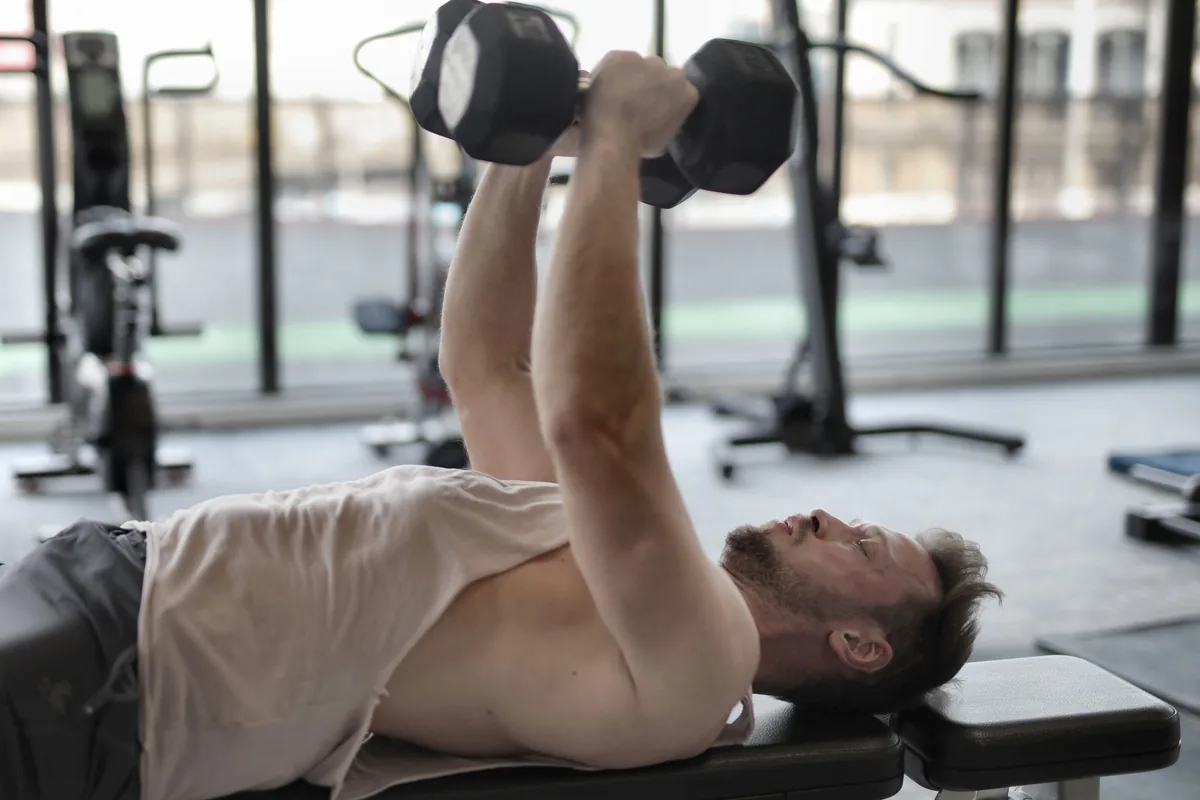
One honest note first. The classic dumbbell press is a bench exercise in the catalog: lie on the bench, weights above the chest, lower to the sides of the ribs, press up without locking hard, for 3 sets of 8 to 10. If you buy a bench later, it should be your first addition. Today, its floor version does the same job, and that is where this session starts.
The dumbbell chest workout at home, exercise by exercise
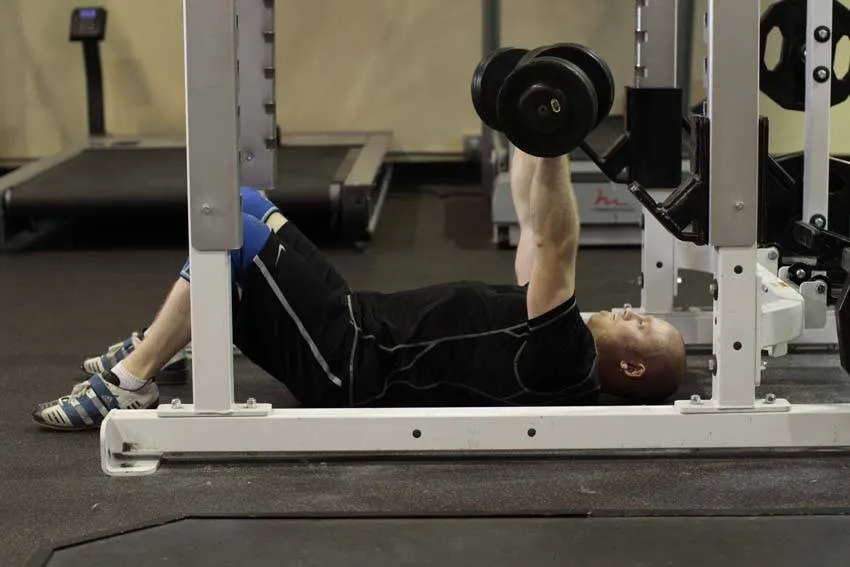
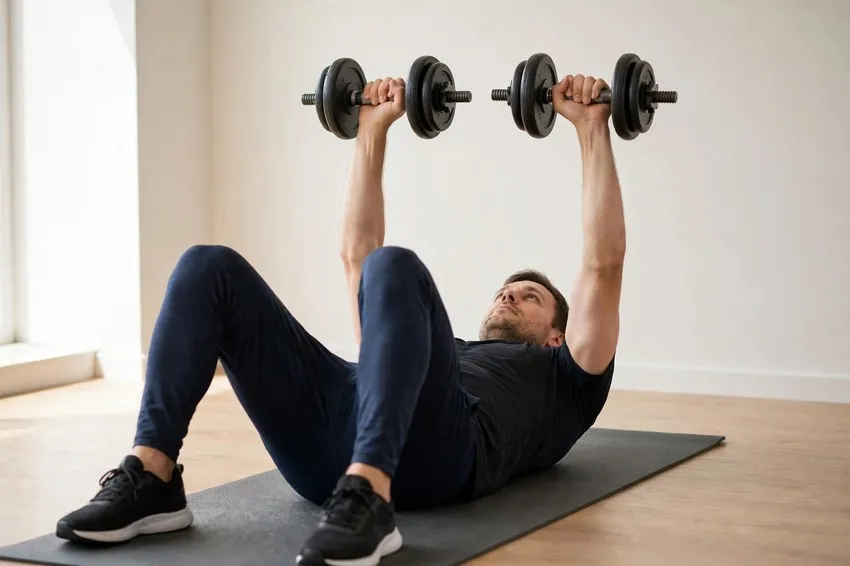
1. Dumbbell floor press. Lie on the floor, weights above your chest. Lower until your elbows touch the floor, then press up without flaring your ribs. The dumbbell floor press is programmed at 3 sets of 8 to 10, and the floor sets your range: your elbows stop at the same place on every rep, so the bottom never drifts deeper as you tire.
2. Dumbbell floor fly. Stay on the floor, weights above your chest, elbows soft. Open your arms until your elbows touch the floor, then bring the weights back together. The dumbbell floor fly works the chest and shoulders at 3 sets of 8 to 12. Go lighter than on the press: this is a stretch-and-squeeze move, and the floor keeps that stretch honest.
3. Dumbbell pullover. One weight this time, held over your chest as you lie on the floor. Lower it behind your head with soft elbows, then pull it back over your chest. The dumbbell pullover is listed for the floor or a bench, works the chest and back, and runs 3 sets of 8 to 12. Keep it slow; the point is the long reach behind your head, not a fast return.
The push-up variations
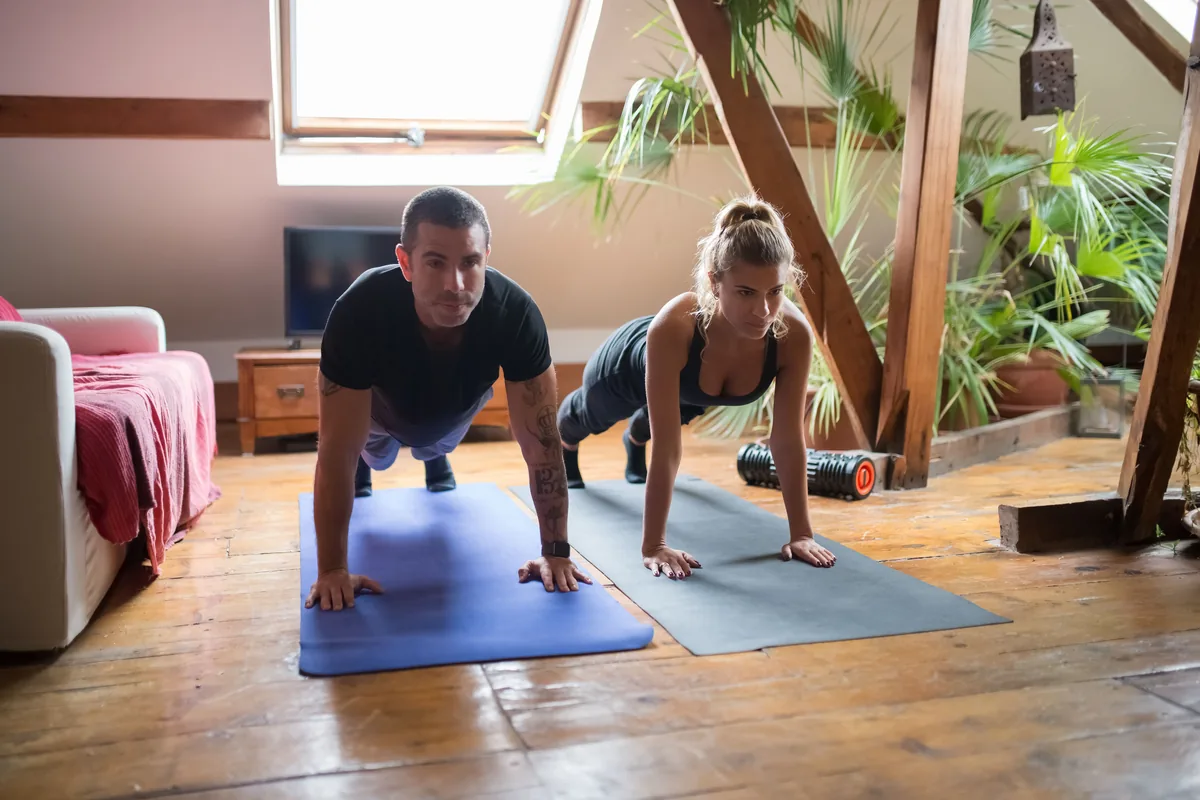
4. Wide push-up. Hands wide apart, body straight, hips not sagging. Lower your chest to the floor and press back up. The wide push-up runs 3 sets of 8 to 12 and shifts more work onto the chest than a standard grip. New to push-up form? Our push-up guide covers the straight-line setup all these variations share.
5. Close-grip push-up. Hands under your ribs, elbows close. Lower, then press up, hips in line. The close-grip push-up is the hardest push-up here at 3 sets of 6 to 10, because the narrow grip asks more of your arms. Fewer clean reps are fine. This is a finisher slot, not a test.
6. Push-up. Finish with the standard push-up: hands under shoulders, body in one line, lower until elbows reach about 90 degrees, press the floor away. Three sets of 8 to 12 is the catalog dose, but your chest is tired by now, so stop each set while your line is still straight. When all six moves reach the top of their rep ranges, the weights can go up next time.
How to run the session
Run the moves in order: loaded dumbbell work first, while you are fresh, push-ups after. Rest between sets until your breathing settles. Twice a week suits most people, with a rest day between sessions, because chest, shoulders and arms press in almost every move here.
Short on time? Cut it to the three dumbbell moves plus one push-up variation; you still cover press, fly and pullover. Our dumbbell workout at home guide shows how chest day fits a full dumbbell week, and home workout without equipment covers days when the dumbbells stay in the corner.
Mistakes that make floor training feel useless
Bouncing the elbows. Touching the floor is a marker, not a trampoline. Pause for a breath, then press. If you need the bounce, the weight is too heavy.
Bending the fly into a press. Once the elbows bend a lot and the weights travel up and down instead of out and together, you are pressing again. Keep elbows soft and fixed; arms open and close like a gate.
Letting the hips sag on push-ups. It shows up in the last sets, when the middle gives up before the arms do. End the set there. Tired reps teach the sag, not the press.
Skipping the light first set. Your shoulders work in every move here. One easy set of floor presses costs a minute and makes the first real set feel settled.
Your first session this week
Clear the floor and run the six moves once at an easy weight to learn the order. Write it down. Next session, use a weight that makes the last two reps of each set feel like work. Rather have the week assembled for you? Take the Setline quiz and it builds sessions from the equipment you actually own, bench or no bench. For the full library of 302 exercises and the planning features, Setline Pro starts with a 14-day trial, then $6.99 a month, $39.99 a year, or $79.99 for Lifetime.
Common questions
Can you build a chest workout without a bench, really?
Yes, with one limit worth naming. The floor shortens the range of the press and fly, because your elbows stop at the floor. What you lose in range, you get back in repeatable form and zero setup. These six moves still cover pressing, opening and reaching, as a bench session does.
What weight should I start with?
Pick a weight that lets you finish the floor press sets with a good rep or two in reserve. The fly and pullover usually need less, so with one pair only, use it for all three and slow the fly down.
How is this different from just doing push-ups?
Push-ups load you with a share of your own bodyweight, and that share never grows as you get stronger; you only add reps. Dumbbells let the load itself grow. The push-up variations add angle and grip variety, and the chest exercise hub shows the full 39-exercise chest library behind them.
When should I add the bench version?
When the floor press feels stable at the top of its rep range for two or three sessions running, a bench adds range and the standard press. Until then, the floor is not a compromise. It is why the session happens at all.