Key takeaways
- Three moves cover the back from three directions: band row 3 sets of 10 to 12, pull-up 3 sets of 4 to 8, band face pull 3 sets of 12 to 15 — pull-up first while you are fresh, row second, face pull last.
- No bar, no band? The inverted row, superman and bird dog cover the same jobs from the floor — the inverted row is also the step that gets you to a first pull-up.
- Two sessions a week on non-consecutive days, adding a rep when every set finishes at the top of the range with clean form.
Back Workout at Home: Three Moves That Cover the Whole Back
A back workout at home starts with a simple problem: you cannot see the muscles you are training, so it is easy to train everything around them instead. The fix is not more equipment. It is picking one move for each job the back does, a pull, a hold, and a hinge, and doing those moves well twice a week. This article builds that session from Setline's back catalog, which lists 57 exercises, using only three things you may already own: a resistance band, a doorway pull-up bar, and the floor.
The band-only corner already has its own guide, and so does the pull-up bar. This is the whole-hub version.
Three moves cover the back because the back does three jobs. A horizontal pull works the middle of the back. A vertical pull works the lats, the broad muscles down each side. A face pull works the upper back and the muscles that draw the shoulder blades together.
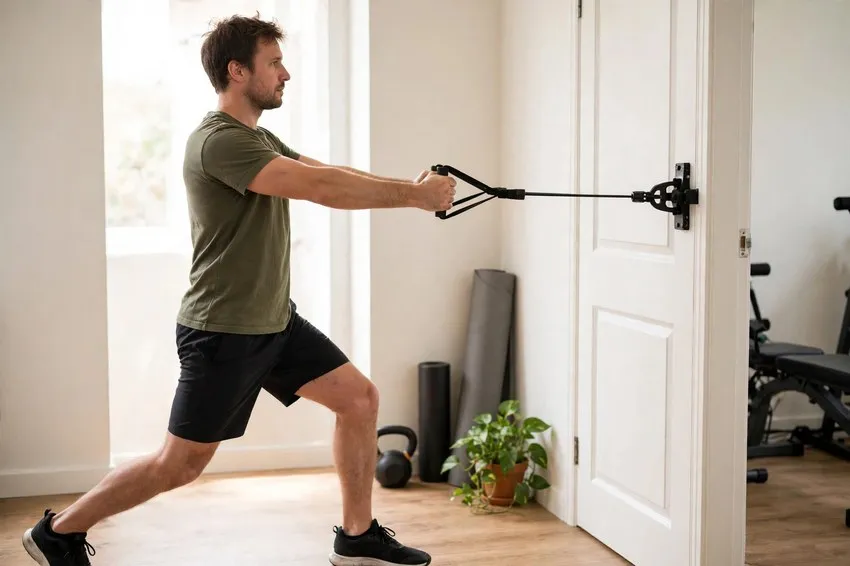
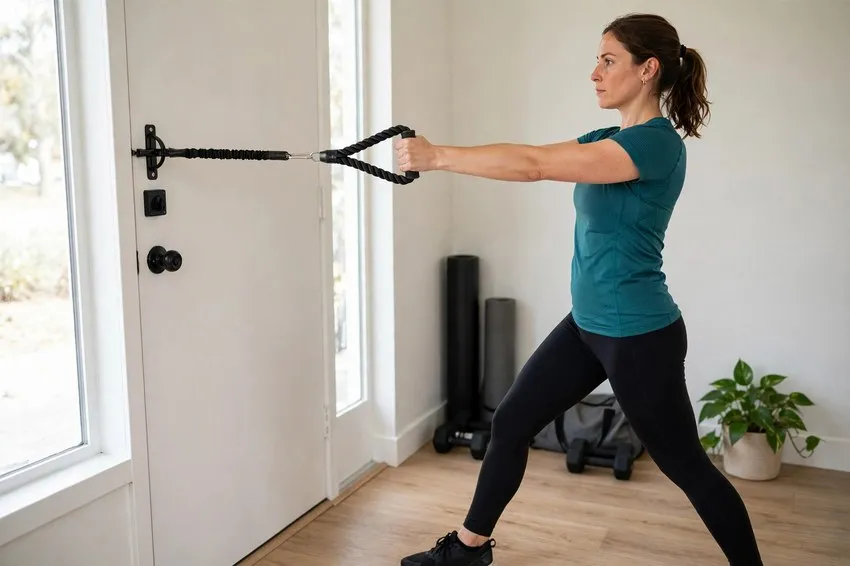
Start with the band row. Anchor the band at chest height, pull your elbows back with your ribs quiet, and return slow without shrugging. In a Setline session it runs 3 sets of 10 to 12. Step back until the band is already under tension at arm's length: a row that starts slack wastes its first half.
Second is the pull-up, the vertical pull. Hang with arms long and ribs down, pull your chest toward the bar, and lower slow without swinging. It runs 3 sets of 4 to 8. Four honest reps beat eight swinging ones. If you cannot do one yet, the inverted row below is the step that gets you there.
The Band Face Pull: The Lightest Move of the Three
Third is the band face pull. Anchor the band at face height, pull toward your face with elbows high, squeeze the shoulder blades, and return slow. It runs 3 sets of 12 to 15. This is the lightest move of the three and the easiest to rush, so treat the squeeze as the rep.
Run them in that order: pull-up first while you are fresh, row second, face pull last. Three moves, nine sets, and the whole back has been worked from three directions.
Hinges and Holds for Days Without a Bar
Some days you have no bar, or no band. Two floor moves plus one bar move cover those days.
The inverted row is the pull-up's understudy. Set the bar low, lie under it and grab a wide grip, pull your chest to the bar with your body in one line, and lower until your arms are long. It runs 3 sets of 6 to 10. The lower the bar, the harder the row. This is also the move to use while you are building toward a first pull-up.
The superman needs nothing but the floor. Lie face down with arms long, lift your chest and legs a little off the floor, pause, then lower without dropping your head. It runs 3 sets of 8 to 12. The lift is small on purpose: if your lower back pinches, you have lifted too high.
The bird dog is the quiet one. Hands under shoulders, knees under hips, reach one arm and the opposite leg long, then return without rocking the hips, and switch sides. It runs 3 sets of 6 each side. Slow it down until the hips stop wobbling.
These three are not filler. The inverted row is a real pull, and the two holds train the back to keep its shape under load.
How to Put the Week Together
Two sessions a week, on days that are not back to back, is enough. Do the three main moves in order, then finish with one hold: the superman on one day, the bird dog on the other. Rest about a minute between sets, closer to two after a hard set of pull-ups.
Progress is simple and it is the whole program. When you can finish every set at the top of the rep range with clean form, add a rep next session. When you reach the top of the range again, add a set. When the pull-up stalls, add an extra set of inverted rows after it. What matters is that the last rep of the last set looks like the first one.
What This Session Leaves Out
Honesty first: this session has no heavy hinge. A hinge loaded with real weight, a barbell deadlift or a Romanian deadlift, needs weights this session does not assume, and both moves sit in the back hub for the day you have them. Until then, the superman and the bird dog train the hinge pattern as a hold, which is useful but not the same as lifting something heavy.
The second gap is the vertical pull. Without a bar there is no pull-up, and the inverted row is the closest substitute, not a replacement. If you train with bands only, the band-only guide to a resistance band back workout covers that version in full. If you do have a bar, the pull-up bar guide walks from the dead hang to the first rep.
Make the Session Match the Plan
A back session works when it is the same session every week, done twice, with one more rep than last time. Pick your gear, run the three moves in order, finish with a hold. Take the quiz to get a training plan matched to your goal and your equipment, and if you want the full version with guided sessions and the complete exercise catalog, Setline Pro is $6.99 a month or $39.99 a year, with a 14-day free trial, and a $79.99 lifetime option.
Common questions
How many times a week should I train my back at home?
Twice a week, on non-consecutive days. The back recovers fast, but the grip and the shoulders do not, so the rest day matters as much as the session.
Do I need a pull-up bar for a back workout at home?
No for a complete session, yes for vertical pulling. The band row, the face pull, the superman, and the bird dog need no bar at all. The pull-up and the inverted row need one, set high for the first and low for the second.
Can I build my back with only resistance bands?
Yes for rows and face pulls, which are two of the three jobs in this article. What bands cannot give you is a vertical pull, so a band-only back day leans on the row as its main move.
I cannot do a pull-up yet. Where do I start?
Start with the inverted row and with hanging from the bar, arms long, ribs down, which is the first step of the pull-up itself. Build the inverted row to 3 sets of 10 with your body in one line, then try a single pull-up.