Key takeaways
- The pull-up bar hub lists six exercises; this article covers the four beginner moves — inverted row, dead hang, chin-up and pull-up — in the order that makes them useful.
- Start with the inverted row and the still hang, then slow lowerings, then chin-ups, then pull-ups; a clean set of fewer reps beats a messy set of more.
- Train the bar two or three times a week with a day between sessions, and finish with the hanging knee raise for core.
Check the bar before you hang from it
A pull-up bar is a small piece of gear with a big reputation. It hangs in a doorway, takes up almost no room, and asks for one thing most beginners cannot do yet: lift your whole body with your arms and back. For pull-up bar exercises for beginners, the honest starting point is not the first rep. It is the hang, the row, and the slow lowering that build up to it. This article works through four moves from the Setline catalog, in the order that makes them useful, and shows how they fit into one session.
The full set lives on the pull-up bar hub, which lists six exercises. This article covers the four beginner moves bound to this topic.
A doorway bar must sit level, grip the frame on both sides, and stay still when you pull down on it with part of your weight first. Stand on a sturdy step, take the bar, and let a little weight into your arms. If the bar shifts or rocks in the frame, stop and refit it. A bar that moves under you will teach you to rush, and rushing is what breaks form.
Clear the space under the bar. You need room to hang with your feet clear of the floor, and room to step off without hitting furniture. Keep the step nearby for every set. Stepping up and stepping down after a set is part of good practice, not a shortcut. It saves your grip for the reps that count.
Pull-up bar exercises for beginners: the four moves
The steps and sets below match the Setline detail page for each move. If your shape breaks down, end the set. A clean set of fewer reps beats a messy set of more.
1. Inverted row. This is the pulling move you can do before you can pull your body weight up. Set the bar low, lie under it, and take a wide grip. Pull your chest to the bar with your body in one straight line, then lower until your arms are long. Keep your hips up through the whole rep. The inverted row is programmed as 3 sets of 6 to 10 reps and works the back and arms.
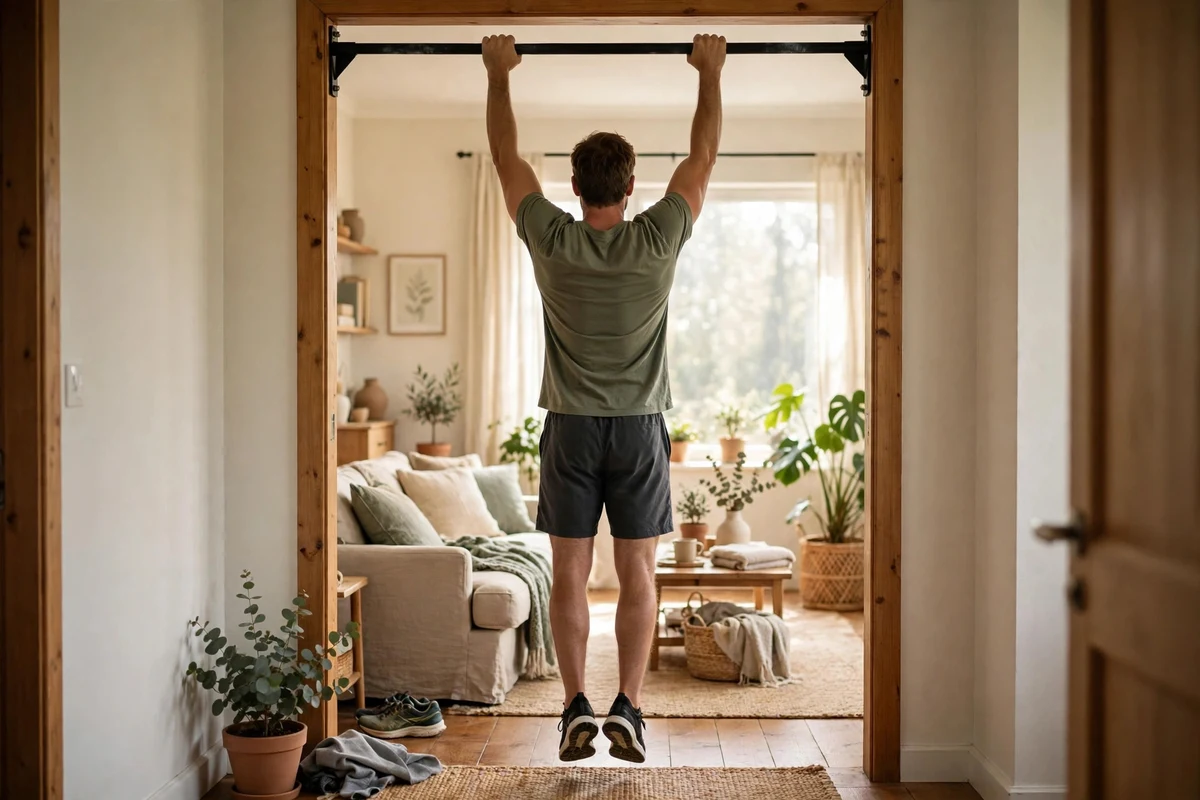
2. Dead hang. The dead hang is the start position of the pull-up, held on its own. Hang with your arms long and your ribs down, shoulders settled rather than shrugged up to your ears. Do not swing. A still hang builds grip and shoulder control. The catalog does not program the dead hang as a separate move with its own sets, so treat it as practice inside your pull-up work: hang still, breathe, and step down when your grip starts to go.
3. Chin-up. Take an underhand grip and hang tall. Pull until your chin clears the bar, then lower under control. Keep your elbows in front of your body as you pull, and do not kick your legs to finish a rep. The chin-up is programmed as 3 sets of 4 to 8 reps and works the back and arms.
4. Pull-up. Hang with your arms long and your ribs down. Pull your chest toward the bar, then lower slowly without swinging. The pull-up is programmed as 3 sets of 4 to 8 reps and works the back and arms. The lowering matters as much as the pull. If you cannot yet pull all the way up, step up to the top, hold for a breath, and lower as slowly as you can with control.
For core work on the same bar, add the hanging knee raise after your pulling sets, so your grip is fresh for the pulls. Hang still with your shoulders packed, lift your knees toward your ribs, and lower without swinging. The hanging knee raise is programmed as 3 sets of 8 to 12 reps and works the core.
From dead hang to first rep, in stages
Stage one is the inverted row and the still hang. Do these until a row set feels controlled from the first rep to the last, and a hang feels still rather than shaky. Stage two is the slow lowering. Step up to the top, then lower with control. When you can lower slowly for a full set, you are close. Stage three is the chin-up, then the pull-up.
Do not test your max every session. Pick one stage, do its sets well, and repeat it until it feels easy before moving on. A beginner who rushes to the pull-up usually ends up swinging, kicking, and doing half reps.
Train the bar two or three times a week, with at least a day between bar sessions. Grip and back work recover slower than they feel the day after, and sore forearms will cut your next session short. On days between bar sessions, a bodyweight session keeps you moving without loading the same grip. The home workout without equipment is a good fallback on those days, and the bodyweight cut at home article covers how a bodyweight block fits a training week.
Put the four moves into one session
A simple session is one row, one pull, and one core move. Start with the inverted row for 3 sets of 6 to 10, then work on your current pull stage: slow lowerings, chin-ups, or pull-ups for 3 sets of 4 to 8. Finish with the hanging knee raise for 3 sets of 8 to 12. Rest between sets until your breathing settles and your grip feels ready again. The whole session fits in a doorway, and it needs no other gear.
Start with the hang, not the rep
Start tonight with a bar check, a still hang, and a set of inverted rows. When the row feels controlled and the hang feels still, add slow lowerings, then chin-ups, then pull-ups. If you want Setline to arrange these moves into a session that fits your gear and your minutes, take the quiz. Pro plans, with a 14-day trial, start at $6.99 per month, $39.99 per year, or $79.99 for lifetime, on pricing.
Common questions
Do I need a doorway bar, or will any bar work?
Any sturdy bar you can hang from with your feet clear of the floor will work, as long as it is fixed solidly and tested before a full hang.
Why can I do chin-ups but not pull-ups?
The underhand chin-up grip lets your arms help more, so most beginners get chin-ups first. That is expected. Keep building chin-up reps and slow pull-up lowerings, and the pull-up usually follows.
How long does the first pull-up take?
There is no honest fixed timeline, because starting strength and body weight differ so much. The stages above are the measure, not the calendar: a controlled row, a still hang, a slow lowering, then a clean rep.
Should I train pull-ups every day to get there faster?
No. Two or three bar sessions a week, with a day between them, gives your grip and back time to recover. Daily bar work usually ends in tired forearms and messy reps.