Key takeaways
- A band back session needs four moves: a row as the main pull, a face pull and a pull-apart for the upper back and shoulder blades, and a hip hinge that loads the glutes while the back holds a flat, braced position.
- Only 4 of Setline's 21 band exercises sit in the back catalog, and there is no band lat pulldown in it - this workout states that gap instead of inventing a move; the pull-up stays the vertical-pull answer when you have a bar.
- Anchor at chest height for the row and face height for the face pull, check the door is latched and the band unnicked before every session, and run the session twice a week in the order written.
What a resistance band back workout covers, and what it misses
Back day is the session home training skips most often. Pressing and squatting are easy to improvise with no gear, but pulling needs something to pull against. A single band and a closed door fix that. This resistance band back workout is built from the four band moves Setline's catalog actually files under back: a row, a face pull, a pull-apart and a hip hinge. There is no band lat pulldown in the catalog, and this article will not pretend otherwise. What the four moves do cover, they cover well: the mid-back, the shoulder blades and the hinge your lower back works through.
Setline's band exercise library lists 21 exercises. Filtered by the site's own back hub, which holds 57 exercises across all equipment, only four of the 21 are back moves. The other 17 are curls, presses, squats and core work, and none belongs in a back session.
The four split into three jobs. The row is the main pull, elbows driving back against a chest-high anchor. The face pull and the pull-apart train the upper back and the muscles that draw the shoulder blades together, the part most home programs never touch. The hip hinge loads the glutes and legs with the back holding a flat, braced position. The gap is vertical pulling: nothing here pulls down from overhead the way a pull-up does. The last section deals with that gap directly.
The four moves, in session order
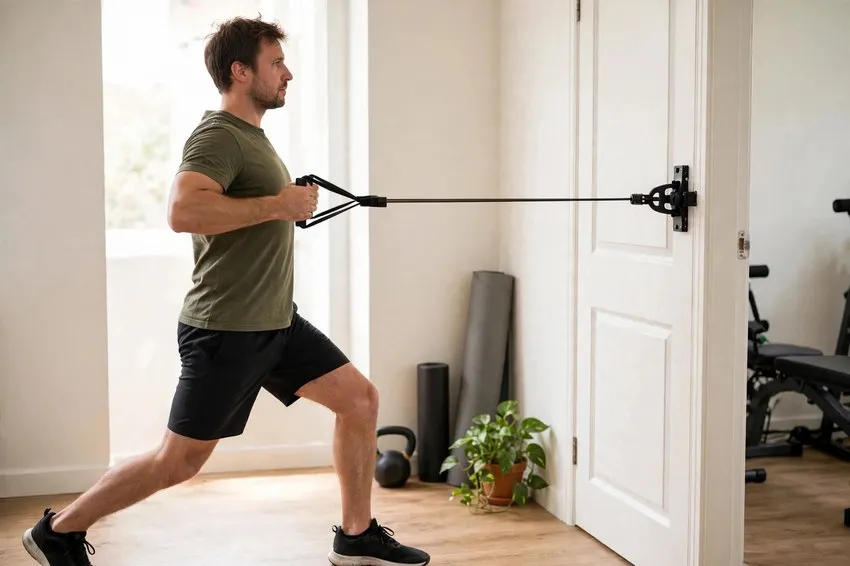
1. Band row, the main pull. Anchor the band at chest height, pull your elbows back with your ribs quiet, and return slow without shrugging. The band row works back and arms at 3 sets of 10 to 12. Step back until the band is already under tension at arm's length; a row that starts slack wastes its first half.
The face pull: upper back and shoulder blades
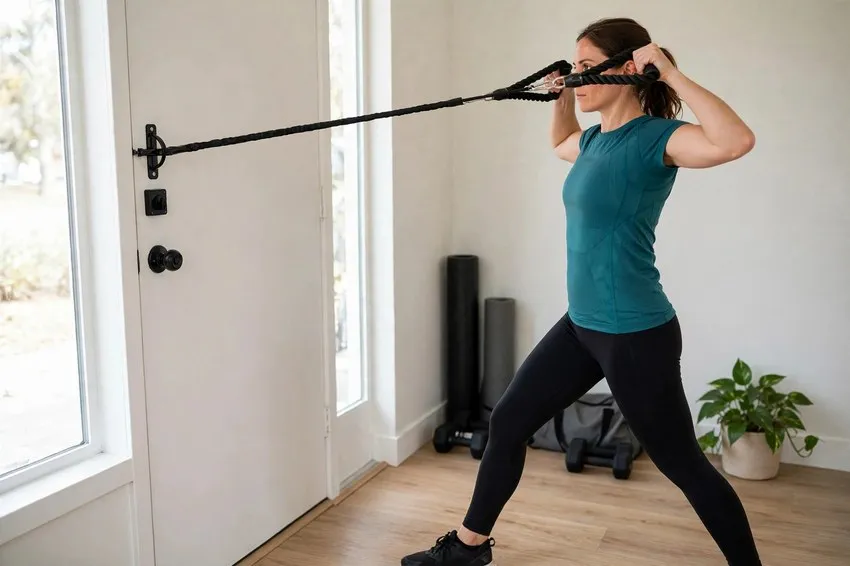
2. Band face pull, the upper back. Anchor the band at face height, pull toward your face with elbows high, squeeze the shoulder blades, and return slow. The band face pull works shoulders and back at 3 sets of 12 to 15. Keep the load light enough that your elbows stay up; once they drop, the row muscles take over and the upper back stops working.
Pull-apart and hip hinge: shoulder blades and the working back
3. Band pull-apart, the shoulder blades. Hold the band at chest height with arms long, pull your hands apart until the band meets your chest, and return slow with ribs quiet. The band pull-apart works shoulders and back at 3 sets of 12 to 15. Start with a band you can open fully; a half-opened pull-apart against a heavy band is just a shrug with props.
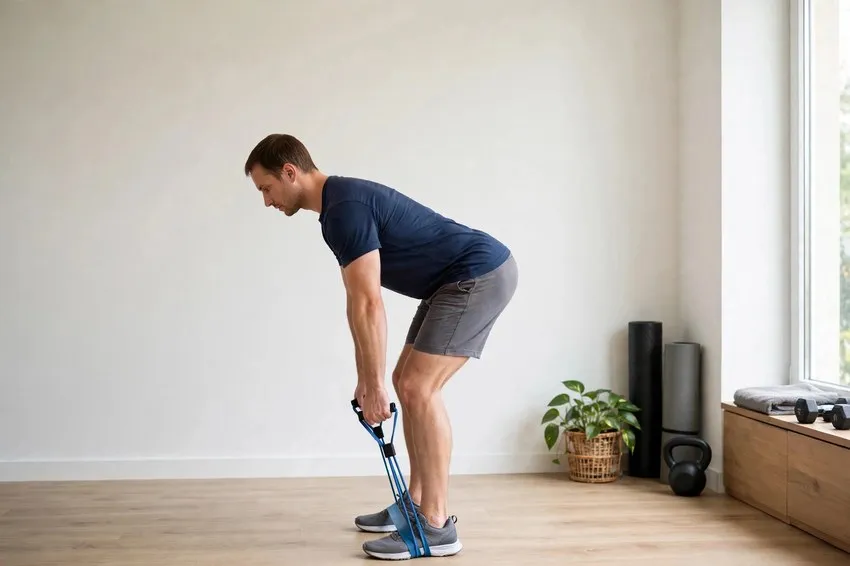
4. Band hip hinge, the back at work holding still. Stand on the band with the handles at your hips, push your hips back until your torso is near flat, then stand by driving your hips forward. The band hip hinge works glutes, legs and back at 3 sets of 10 to 12. Your back does not lift this one; it stays flat and braced while the hips move, which is exactly the job it has in every deadlift variation.
Set the door anchor up properly
Two of the four moves hang off a door anchor, at chest height for the row and face height for the face pull, so the anchor is part of the equipment. Seat the anchor on the hinge side or over the top of the door, close the door fully, and check it is latched before the first rep. Stand so the door would swing away from you if it moved, not toward you. Before each session, give the band a hard test pull at working length and look it over where it bends around the anchor; a nicked band fails under load, not at rest.
How to run the session, and how it fits a week
Run the moves in the order above: the row while you are fresh, the two upper-back moves in the middle, the hinge last. Rest until your breathing settles between sets; nothing here is timed. Twice a week is a good starting rhythm for a pulling session, and how many days a week to work out shows how back days sit inside a full week without crowding out everything else.
Progress without buying a second band first: step a little further from the anchor, slow the return down, or add reps toward the top of each range. When the top of every range feels steady, a heavier band is the honest next step. Band days also pair cleanly with the sessions in dumbbell workout at home and the gear-free days in home workout without equipment, as long as pulling shows up twice somewhere in the week.
The vertical-pull gap, stated plainly
A band back session with no overhead pull is a partial back session, and saying so beats hiding it. If you have a bar, the pull-up is the missing pattern: hang with arms long and ribs down, pull your chest toward the bar, lower slow without swinging, programmed at 3 sets of 4 to 8. If you have no bar, let the row carry the pulling load; the row and the pull-up overlap a good deal, they are just not the same line of pull. What not to do is anchor a band overhead and call the result a lat pulldown as if the catalog backed it. It does not.
Start with the row tonight
Anchor the band at chest height, check the door is latched, and do the row and the face pull, three sets each. That is twenty minutes and the two moves most home back training never gets to. Want the full week arranged around the gear you actually own? Take the Setline quiz and it builds sessions from your equipment, bands included. Setline Pro opens the full library of 302 exercises and starts with a 14-day free trial, then $6.99 a month, $39.99 a year, or $79.99 for Lifetime.
Common questions
Which band strength should I start with?
Pick by the row, the heaviest move here: the right band lets you finish 10 to 12 reps with your ribs quiet and no shrug on the last two. The same band will feel easy for the pull-apart and about right for the face pull. One medium band covers this whole session for most beginners.
Can this replace pull-ups?
No, and the article is built around that fact. Rows pull toward your ribs, pull-ups pull you up toward a bar; the back works in both, along different lines. Do this session for what it trains well, and add pull-ups when you have a bar rather than expecting a band to imitate one.
Why is there no band lat pulldown in the list?
Because Setline's catalog does not contain one. Every move in this workout is a real catalog exercise with its own detail page, steps and demo. Four real moves with a stated gap beat six moves where two were invented for the article.