Key takeaways
- Five dumbbell moves, one pair of dumbbells, no bench, no rack, no cable machine: shoulder press 3 sets of 8 to 10, Arnold press 3 sets of 8 to 10, lateral raise 3 sets of 10 to 12, scaption 3 sets of 10 to 12, rear fly 3 sets of 10 to 12.
- Run them in order — presses while fresh, raises in the middle, the rear fly last — twice a week on non-consecutive days; the whole set takes roughly half an hour.
- Form over range: keep the ribs down on presses, keep the shoulders down on raises, and prefer a shorter, flat-backed rear fly rep to a big, swinging one; stop any move that hurts a joint instead of stopping the session.
Dumbbell shoulder exercises at home need one pair of dumbbells and a patch of floor
These dumbbell shoulder exercises at home need one pair of dumbbells and a patch of floor. No bench, no rack, no cable machine. Five moves cover the job: a straight overhead press, a rotating press, a side raise, a diagonal raise, and a rear raise for the back of the shoulder. Every step below comes from the Setline exercise catalog, and every move is filed under the shoulders exercise library.
Dumbbell shoulder exercises at home: the five-move set
Work through the moves in order, with a short rest between sets.
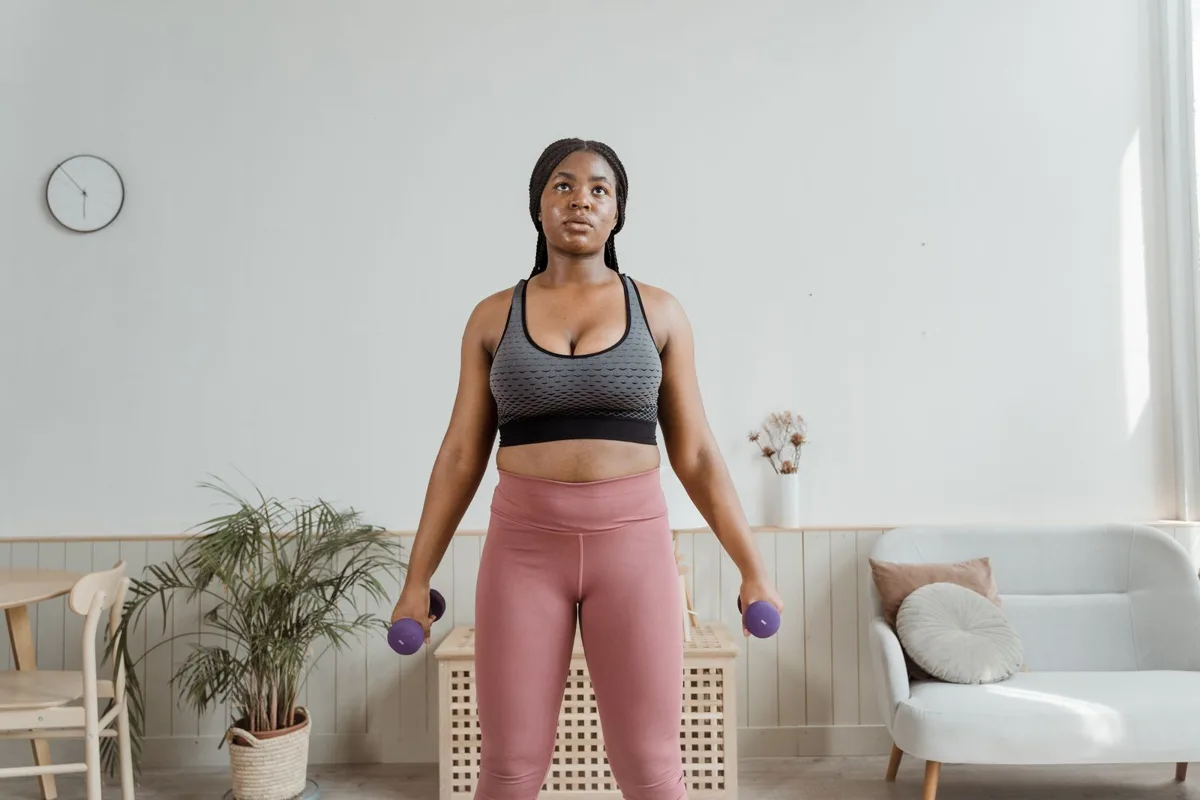
1. Dumbbell shoulder press. Stand or sit tall, weights at the shoulders. Press overhead until the arms are long, then lower to the shoulders without arching. The dumbbell shoulder press works the shoulders and arms at 3 sets of 8 to 10. This is the main strength move of the set, so do it first, while you are fresh.
2. Arnold press. Sit with back support, dumbbells at upper chest level, palms facing your body. Raise the dumbbells while rotating your palms forward until your arms are extended overhead. Pause, then lower while rotating the palms back toward you. The Arnold press runs 3 sets of 8 to 10. The rotation is the whole point: it takes the shoulder through a longer path than a straight press, so keep the weight lighter than in move 1 and keep the rotation smooth, not rushed at the top.
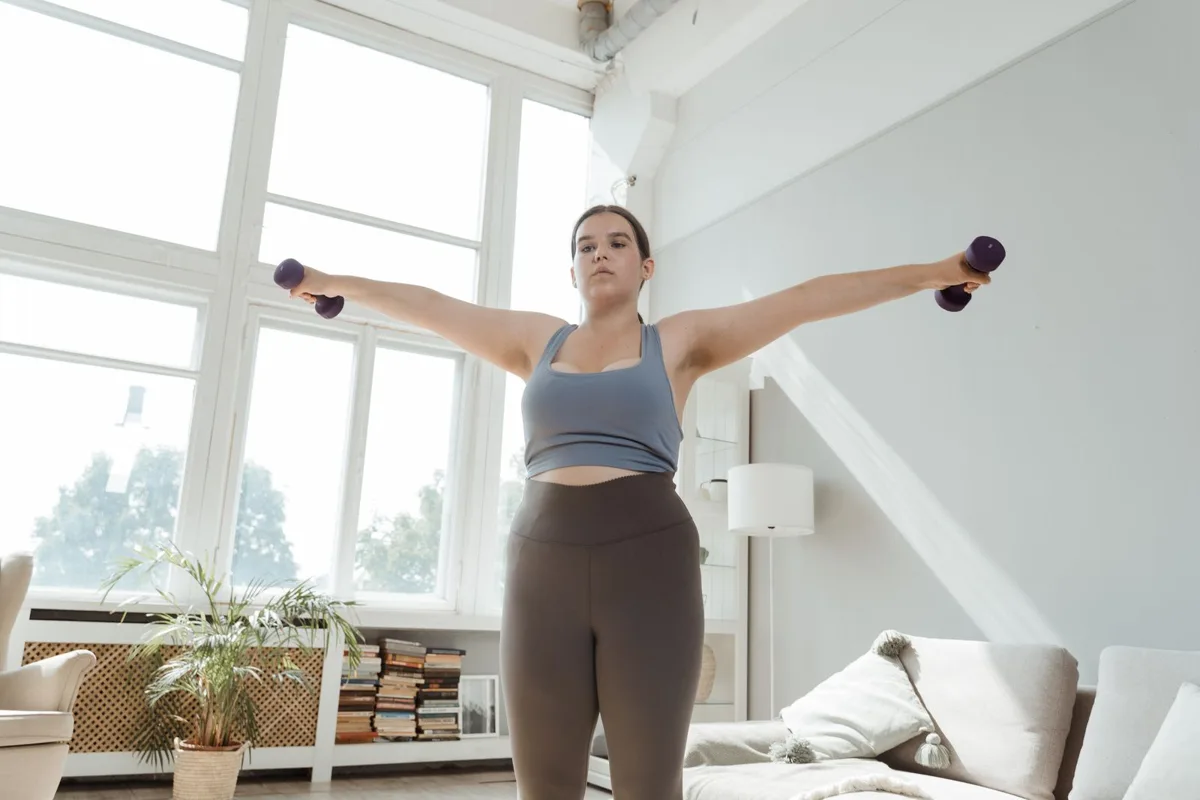
3. Dumbbell lateral raise. Arms hang, with a slight bend in the elbows. Raise the weights to shoulder height, then lower slow. Do not shrug. The dumbbell lateral raise runs 3 sets of 10 to 12. Stop at shoulder height. Higher than that, the traps take over and the side of the shoulder stops doing the work. If your shoulders rise toward your ears on every rep, the weight is too heavy.
The diagonal raise and the rear fly: moves four and five
4. Dumbbell scaption. Hold a light dumbbell in each hand, hanging at your sides, thumbs pointing up. Raise both arms up and out at about 30 degrees between front and side, arms long. Stop when your arms are parallel to the floor, then lower them with control. The dumbbell scaption runs 3 sets of 10 to 12. Think of it as a raise on a diagonal: not straight in front, not straight out to the side, but between the two. That angle tends to feel kinder on sore shoulders than a straight front raise.
5. Dumbbell rear fly. Hinge, back flat, weights hanging. Open the arms wide, squeeze the shoulder blades, then return slow. The dumbbell rear fly works the shoulders and back at 3 sets of 10 to 12. Most people skip this one, and most people have shoulders that round forward. Do not skip it. Keep the back flat through the whole set. If the torso rises as the arms open, the weight is too heavy or the hinge has collapsed.
How to run the session, and how often
Run the moves in the order above: presses while you are fresh, raises in the middle, the rear fly last, when good form matters most and fatigue shows up first. Twice a week, with a day between sessions, suits most people. The whole set takes roughly half an hour at an unhurried pace.
How many days a week to work out shows how two shoulder sessions sit inside a full week without crowding the other days. If you already train chest with dumbbells, keep the sessions apart: the press in this set and the pressing in dumbbell chest workout at home share a lot of the same muscles, so stacking them back to back leaves the second session weaker than it should be.
Seated or standing? The catalog lists a seated dumbbell press as its own move: sit with back support, raise the dumbbells to shoulder height with palms facing forward, press up until they touch at the top, pause for a second, then lower slowly back to shoulder height, at 3 sets of 10 to 12. If standing presses make your lower back arch, use the seated version for move 1. The shoulders get the same work, and the back gets a chair to lean on.
Form cues that keep the work in the shoulders
Three mistakes show up in almost every shoulder session. First, the lower back arches on presses. On both presses, the ribs should stay down and the press should stop where the back starts to arch. Sit down if standing will not stay honest. Second, the traps shrug on raises. On the lateral raise and the scaption, the shoulders should stay down while the arms rise. If they will not stay down, the set is done. Third, the range outruns control on the rear fly. A shorter, flat-backed rep trains the rear shoulder. A big, swinging rep trains momentum.
If a move hurts a joint, stop that move, not the session. Shorten the range next time, and get a joint that keeps complaining checked. None of this replaces medical advice for an injured shoulder.
Try it as a planned session
You do not have to remember the order, the sets, or the reps. Take the quiz and Setline will arrange these moves into a session that fits your gear, your style, and your minutes. The free player stays free. Pro adds the extras, with a 14-day free trial after you subscribe, at $6.99 a month, $39.99 a year, or $79.99 once for Lifetime. See the full breakdown on the pricing page before you decide.
Common questions
Do I need a bench or a rack for this?
No. All five moves are tagged with dumbbells in the catalog, and none of them needs a bench, a rack, or a cable machine. A chair with back support helps for the seated press option, but it is a chair, not gym equipment. The wider dumbbell workout at home uses the same one-pair setup for the rest of the upper body.
How heavy should my dumbbells be?
Heavy enough that the last two reps of a press feel hard, and light enough that the raises stay strict. In practice that usually means two different weights: a heavier pair for the presses and a lighter pair for the raises. One pair can work if it is on the lighter side, but do not let the press weight decide the raise weight. The raise will lose.
Can I do this every day?
Every day is a bad trade for the same muscles. The shoulders recover like any other muscle group, so two sessions a week on non-consecutive days beats a daily grind that never recovers. Pair this set with a different muscle group on the other days rather than repeating the same five moves.
What if overhead pressing bothers my shoulders?
Start with the scaption and the rear fly, which keep the arms lower and the path more diagonal, and leave the straight overhead press out until the shoulder feels settled. If overhead work keeps bothering the joint, get it checked rather than pushing through it. A session that hurts is not a session that builds.