Key takeaways
- Six suspension moves, two straps and one anchor: row 3 sets of 10, push-up 3 sets of 10, lunge 3 sets of 8 each side, face pull 3 sets of 12, knee tuck 3 sets of 10, triceps extension 3 sets of 10 — no bench, no rack, no extra weights.
- Angle is the weight selector: step closer to the anchor to make a move easier, walk the feet away to make it harder; run the set twice or three times a week with a rest day between, about half an hour per session.
- Keep one straight line — head, hips and heels — on every move, and stop any move that hurts a joint instead of stopping the session.
Suspension trainer exercises at home need two straps and one anchor point
A suspension trainer is two straps, two handles, and one anchor point. That is the whole kit, and it is enough for a full session, because your own body weight is the resistance and your foot position is the weight selector. Step closer to the anchor and a move gets easier. Walk your feet away from it and the same move gets harder, with no plates to change. This starter set uses six moves from the Setline catalog: a pull, a press, a leg move, a high pull for the upper back, a core move, and an arm finisher. Steps below come from the suspension trainer exercise library.
Before you start: anchor, angle, and one straight line
Set the anchor first and test it before you load it. The straps must hang from a point made to hold your weight, with the handles hanging free. Every move rests on the same position: head, hips, and heels in one line, ribs down, no sag at the waist. If the line breaks, the move loads the lower back instead of the muscles it is meant to train.
Angle is how you scale each move. Walking your feet toward the anchor makes the body more upright and the move easier; walking them away makes it flatter and harder. Start at an angle where every rep stays controlled, then move out one small step next time.
Suspension trainer exercises full body: the six-move set
Work through the moves in this order, with a short rest between sets. Big pulls and presses come first, while you are fresh; core and arm work comes last.
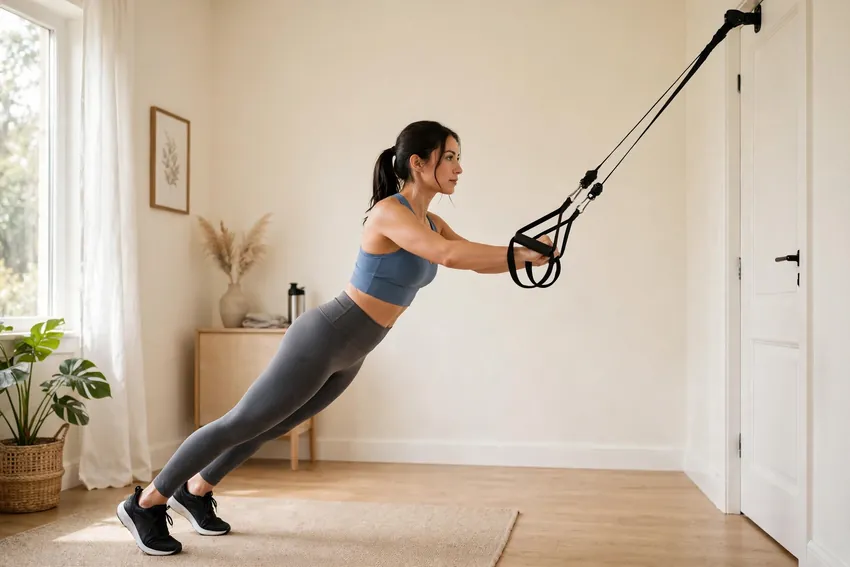
1. Suspension row. Set the straps to about chest height and grip the handles with your palms facing each other. Walk your feet forward and lean back until your arms are straight and your body forms one line. Pull your chest toward the handles, driving your elbows behind you, then lower slowly until your arms are straight again, keeping your body rigid. The suspension row is programmed as 3 sets of 10. Walk your feet back if your hips drop.
The push-up: move two
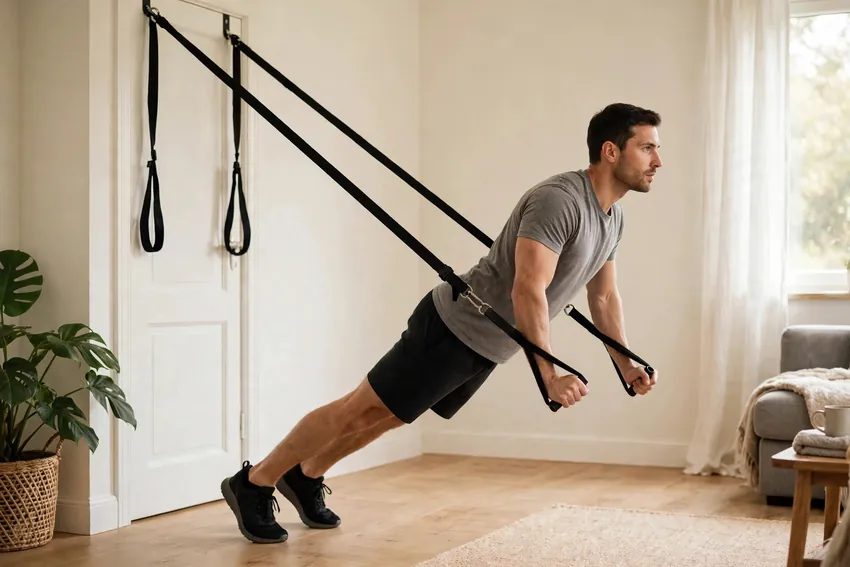
2. Suspension push-up. Set the straps low, near knee height, and grip the handles under your shoulders. Step back into a plank with your body in one straight line. Lower your chest between the handles, keeping the straps clear of your arms, then press back up without letting your hips sag. Keep the handles steady, with no swinging between reps. The suspension push-up runs 3 sets of 10. The handles move, so the core holds the plank while the chest and arms press.
The lunge: move three
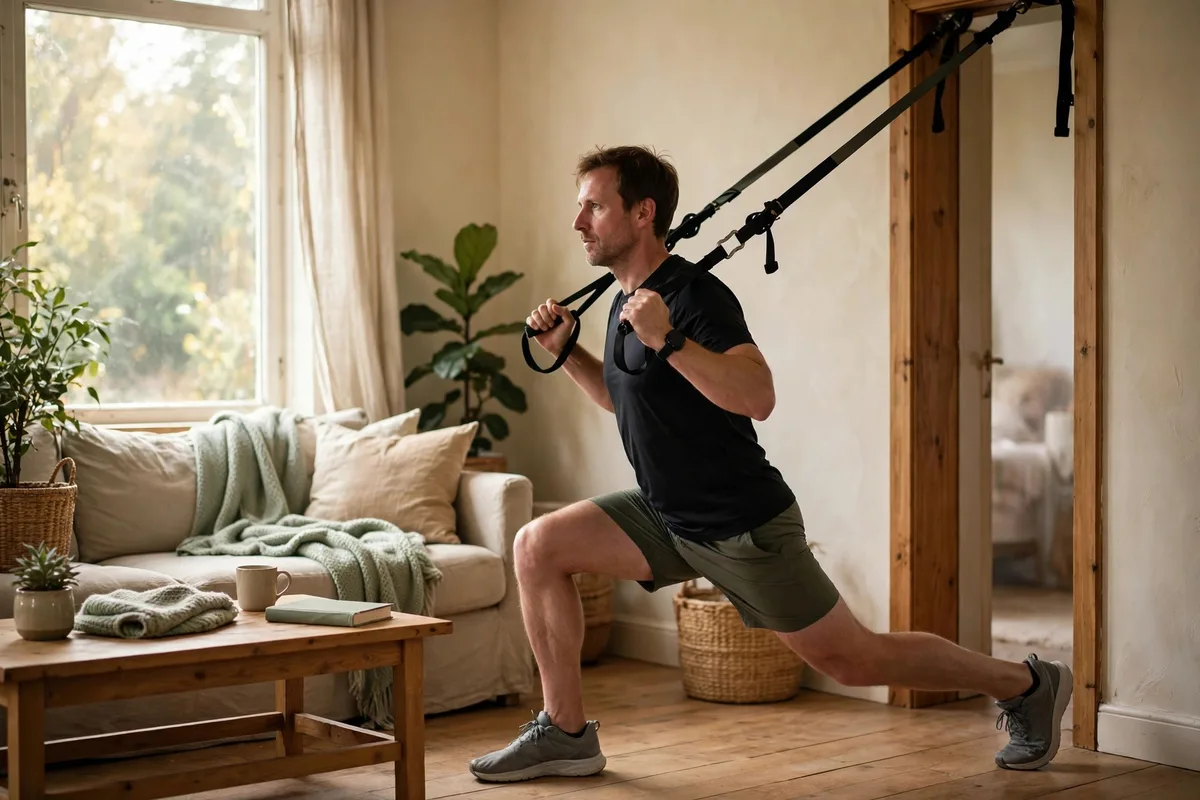
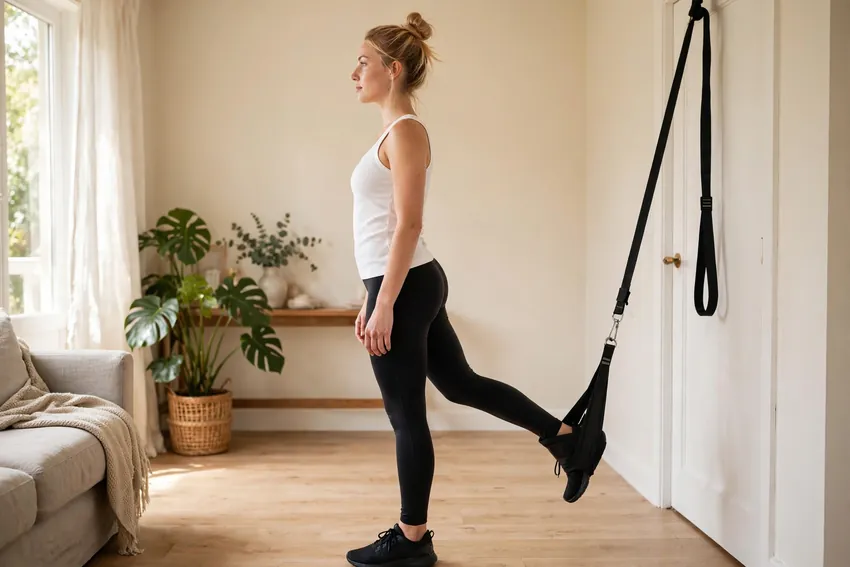
3. Suspension lunge. Stand facing away from the anchor with one foot in a strap behind you. Hold a wall or chair for balance if you need to. Lower straight down until the front thigh is near parallel, then drive through the front heel to stand back up, keeping your torso tall and your front knee tracking over your toes. The suspension lunge runs 3 sets of 8 on each side. The strap holds the back leg up so the front leg does the work.
The high pull, the core move, and the arm finisher: moves four to six
4. Suspension face pull. Face the anchor and grip the handles with an overhand grip, arms straight. Lean back into a straight body line. Pull the handles toward your forehead, elbows high and wide, then rotate so your knuckles finish pointing back, and lower slowly to straight arms. The suspension face pull runs 3 sets of 12. It trains the upper back and the back of the shoulders.
5. Suspension knee tuck. Start in a plank with your feet in the cradles and your body in one line. Draw both knees in toward your chest, then straighten the legs back out without dropping your hips. Keep your hands planted under your shoulders, and move slowly, with no swinging of the straps. The suspension knee tuck runs 3 sets of 10. Keep it slow: a swinging tuck trains momentum, not core.
6. Suspension triceps extension. Face away from the anchor, arms straight out in front at shoulder height, gripping the handles. Lean forward with your body in one line and your weight on your toes. Bend the elbows and let your body drift forward until your hands pass your head, then press through your palms to straighten the elbows and return, keeping your upper arms still so only the forearms move. The suspension triceps extension runs 3 sets of 10. Keep the shoulders still.
Together they cover the session: row for back and arms, push-up for chest and arms, lunge for legs and glutes, face pull for back and shoulders, knee tuck for core, and triceps extension for arms. Next steps in the same suspension trainer exercise library include the pike, the fly, and the hamstring curl.
How to run the session, and how often
Run the six moves in the order above, twice or three times a week, with a rest day between sessions. The whole set takes about half an hour, including rests. Do not repeat it on consecutive days: tired muscles train sloppy reps, not strength. How many days a week to work out shows how two or three full sessions fit a week.
If you already train without equipment, home workout without equipment covers the floor version of the same idea, and the straps add the pull that floor work cannot give you at home. If you train with dumbbells, keep the sessions apart: the pressing here and in dumbbell workout at home share the chest and arms.
Try it as a planned session
You do not have to remember the order, the sets, or the reps. Take the quiz and Setline will arrange these moves into a session that fits your gear, your style, and your minutes. The free player stays free. Pro adds the extras, with a 14-day free trial after you subscribe, at $6.99 a month, $39.99 a year, or $79.99 once for Lifetime. See the full breakdown on the pricing page before you decide.
Common questions
Do I need anything besides the suspension trainer?
No. All six moves are tagged with the suspension trainer in the catalog, and none needs a bench, a rack, or extra weights. You need the trainer, a secure anchor point, and enough floor space to lean back and lunge.
Can a beginner start with this set?
Yes, because the angle makes every move adjustable. Start upright, close to the anchor, and move the feet out only when the current angle stays clean for all sets. The lunge allows a wall or chair for balance, as written in its steps.
How is this different from a normal bodyweight session?
The difference is the pull. Floor work trains pushes, squats, and core well, but a real horizontal pull at home is hard to set up without equipment. The straps give you that pull, plus an unstable press and a suspended core move.
What if a move hurts a joint?
Stop that move, not the session. Shorten the range, step back to an easier angle, and get a joint that keeps complaining checked. This is not medical advice for an injured joint.